

The Reptile Room has Bugs!!!

Our geckos and dart frogs get a lot of attention here at The Reptile Room but we have a lot more to see here if you look close enough! We have bugs!!!

Insects, beetles, arachnids and invertebrates can make fantastic little pets for people who are short on space, who are renting and cant officially have a
pet, collectors who have gotta catch em all and people who, like me, are bug enthusiasts!
Heres how we care for them......
Mantids

We currently have three preying mantids in The Reptile

Room….
Briar; a flower mantis, Rose; an orchid mantis, and Myrtle; a ghost mantis.
Myrtle is the oldest and biggest so she has the biggest enclosure- a 30x30x30 live planted fully bio-active Exo Terra.
As Briar and Rose are still only babies they are both kept in 10x10x20 acrylic enclosures with fake plants.
Our mantids are fed primarily roach babies with the occasional cricket.
Spiders
This may surprise some but we actually have two pet arachnids in The Reptile Room;

Avie, my Pink toe tarantula sling, and Peter a house spider I rescued from being flushed down the plug hole three months ago decided to keep.
Peter has molted twice since being with us, he’s kept in an acrylic 10x10x10 enclosure with sphagnum moss substrate and some branches to climb/web up. I'm still unsure of his species at the moment, one thing i'm not unsure of is his appetite! Peter crushes crickets and roaches every week.

Until recently Avie was in a similar set up but has since been moved into a 20cm tall "coffin" enclosure with both a flat and twin cork bark tunnel in the back, long "ever flame" grasses to the side and live moss at the base, we use a bark mix for substrate. I cant wait to watch her web it up!
Avie is now taking small crickets and baby roaches.
Isopods
Oh I love my isopods. We keep Seven species of isopod in The Reptile Room; Dairy cows, Powder orange, Powder blues, both Yellow and white zebras, red panda king, and Rubber ducky’s.

Most of our isos are kept in very similar set ups - a plastic tub of organic soil mixed with sphagnum moss and leaf litter, a few branches or pieces of cork bark. Air holes in the lid and they are good to go.

Then there are our special isopods - my current favourites. The yellow zebras are always out and about, very easy to spot and are just so cute. I actually have three separate set ups for them - one tub as a back up colony, one live planted bio-active ikea

greenhouse
colony, and one live planted bio-active iso jar as an experiment- a very successful experiment. Isopods, as it turns out can live anywhere as long as their needs are met; Hides, humidity and food.
I feed my isopods a mix of fish flakes, carrot peelings, dead roaches, mealworm beetles and crickets, as well as specialised isopod foods that we supplement in once a month.
Our feeders
To maintain a constant food supply for our resident geckos and dart frogs we keep colonies of meal worms, lobster roaches, flightless fruit flies, earth worms and crickets.
I’ll go through each set up step by step in the hopes that this will help others start producing their own bugs for their beasties.
Meal worms
Our meal worms are kept in a plastic tub with two inches of oats as substrate. They have cardboard toilet rolls and egg cartons placed in for hides. We feed them carrots, broccoli, potato and parsnip. Apple peelings tend to attract flies so we only use them sparingly.
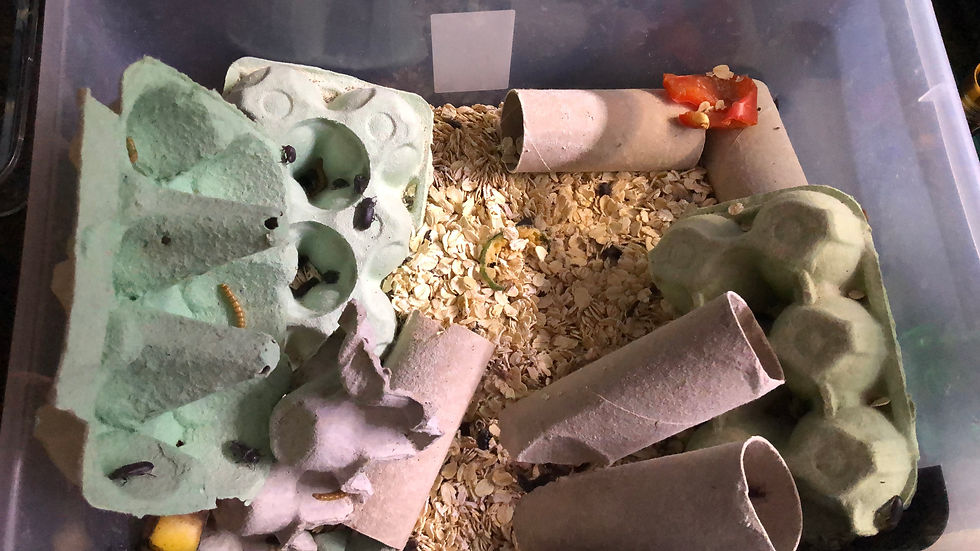
To start your infinite mealworm farm you only need to buy one box of mealworms from your local pet store, plonk them in and feed them. They will do the rest! They can’t climb plastic so there is no need for a lid. They get all the moisture they need from their food so you don’t need to provide water. Eventually your mealworms will pupate and emerge as black beetles, these beetles will lay eggs in the substrate who will then hatch out into new meal worms.
Once the beetles die off you can remove the bodies and feed them to your isopods or place them into a bio-active vivarium to become fertiliser for your plants.
We give our cresties and our leopard gecko mealworms as an occasional treat - and our chickens absolutely love them!
Lobster roaches
As we don’t keep any large lizards that require larger prey items, we primarily use lobster roaches to feed our geckos, mantids and arachnids.
Now unlike a lot of feeder roaches, lobster roaches need heat and CAN CLIMB plastic and glass so the set up for keeping them is slightly more difficult than the mealworms.

We use a large black tub with a secure lid, smear a 2-3 inch layer of Vaseline around the top - roaches can not walk over Vaseline - this prevents them from escaping. We also had to drill a large ventilation hole on the left side and cover with mesh, whilst a heat mat is placed on the right side set to 25.C on a thermostat. We use a deep layer of vermiculite as a substrate, one half of the enclosure has egg cartons and toilet rolls that they use as hides, the other side has a pile of food. We feed our roaches exactly the same as our mealworms - potato peelings, carrots, parsnips

and broccoli, with the addition of lettuce and cucumber for extra moisture.
When feeding the cresties we only use adult males (the ones with wings) and leave the females, this ensures the sustainability of the colony.
Our mantids and arachnids get babies of differing sizes depending on their needs.
Earth worms
Antonio, our axolotl, loves his worms so in order to provide a constant supply for him we started an earth worm farm.

For this you will need two black plastic tubs and one lid. Place one tub down and add layers of cardboard and sand like a lasagne this is your drainage tub, it will prevent the main tub from becoming water logged. Drill holes in the sides and bottom of your other tub then place it inside the intact tub. Next you add a layer of cardboard, organic soil,
(clean and dried) leaf litter, more organic soil and two tubs of earth worms. Drill small ventilation holes in the lid, feed them and seal them up.
We feed our worms exactly the same as the roaches with the addition of tea bags, egg shells, leaves that have not thrived on our plants, hair algae from the aquarium and excess aquatic plants that have grown out of control.
Antonio gets two worms a day, never the biggest as they are breeders that we need for the next generation.
Flightless fruit flies
Our twelve resident dart frogs can get through 200 flies a week so we keep a constant supply of flies on standby for them. To keep up with their feeding schedule I make three fly cultures every Sunday without fail.

We use Nekton Fruit fly media, wood wool and plastic deli pots.
Begin by mixing your media with boiling water 50/50, allow to cool, add wood wool to fill the tub. Then take a blooming culture and shake in 20 or so fruit flies. Seal it up and forget about it for three weeks.
One fly culture should last four weeks but will only be use-able once it’s booming which occurs in its third to fourth week. With this in mind it is very important that you DO NOT miss a week as it will mean you will have no flies in three to four weeks time. I swear the hardest part of keeping dart frogs is remembering to make your cultures on time!
Crickets

I can not for the life of me breed crickets - I’ve been trying for years and I just can’t get it right! BUT I can tell you have to make your box of crickets last for weeks and it’s the simplest trick ever ….. are you ready?…..FEED THEM!
That’s it, that’s the trick. My cricket enclosure has vermiculite as substrate to prevent unwanted smells, I tip a box of crickets in and give them a few egg cartons to hide in and feed them carrots, broccoli and cucumber slices. Top up the food when it gets low. I can make a box of teeny tiny crickets last a month easily. Can’t breed them, but hey - we can’t all be great at everything!


Comments